Currently Empty: ₨ 0

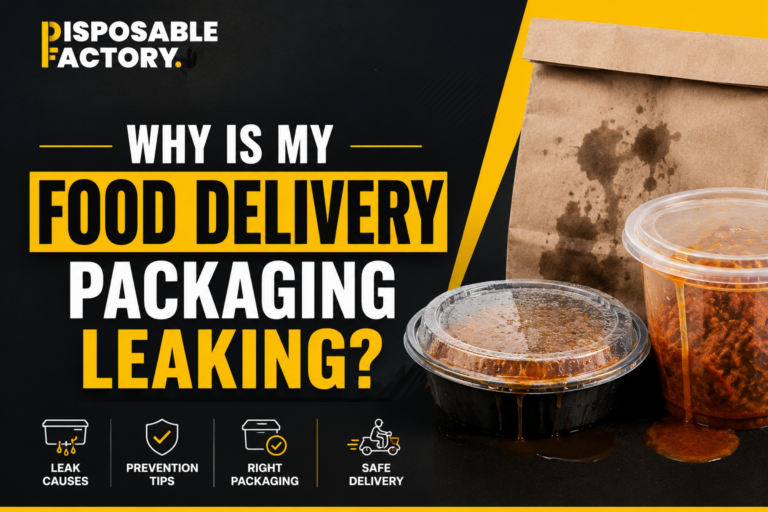
Why Is My Food Delivery Packaging Leaking? Common Causes and How to Fix Them
Your customer places an order for a family-sized chicken karahi.
The food is prepared perfectly.
The aroma is amazing.
The rider picks up the order and begins the journey.
Twenty minutes later, the customer receives the food.
But there’s a problem.
Oil has leaked into the delivery bag.
The container lid is partially open.
The napkins are soaked.
The customer hasn’t even tasted the food yet, but their experience is already damaged.
Sound familiar?
Food packaging leaks are one of the most common problems faced by restaurants, cloud kitchens, caterers, and food delivery businesses in Pakistan. Unfortunately, many business owners assume the packaging itself is the problem when the real cause is often a combination of packaging choice, food type, filling methods, and transportation conditions.
The good news is that most packaging leaks can be prevented.
Let’s explore the real reasons why food delivery packaging leaks and what you can do to stop it.
Why Packaging Leaks Are More Serious Than You Think
A leaking container doesn’t just create a mess.
It affects:
- Customer satisfaction
- Food presentation
- Brand reputation
- Online reviews
- Repeat orders
- Delivery efficiency
Many customers will forgive a delayed order.
Few customers will forgive a leaking one.
When food arrives damaged, customers often assume the restaurant lacks professionalism, even if the food tastes excellent.
The Most Common Cause of Packaging Leaks
Using the Wrong Container for the Food
Not all food containers are designed for every type of meal.
This is one of the biggest mistakes food businesses make.
Imagine serving oily biryani, karahi, or curry inside a container designed for dry foods.
The container may perform well initially, but once exposed to heat, movement, and pressure during delivery, leakage becomes more likely.
Foods that commonly cause problems include:
- Karahi
- Nihari
- Haleem
- Curry dishes
- Daal
- Soups
- Gravy-based meals
- Oily rice dishes
These foods require containers with secure-fitting lids and sufficient capacity.
For larger food portions, options such as Plastic Container Transparent 1000ml, Plastic Container Transparent 1500ml Rectangle, Plastic Container Black C 1500ml, and Plastic Container Black C 2000ml provide additional space and stability.
Overfilling Containers
Many restaurants try to maximize portion size by filling containers to the very top.
While customers appreciate generous servings, overfilled containers often create leakage.
Here’s why.
When the lid closes against the food, pressure builds inside the container.
During transportation, every bump and turn pushes food against the lid.
Eventually, liquid escapes through small gaps.
A simple solution is leaving a small amount of space between the food and the lid.
This gives the contents room to move without forcing liquid outward.
Hot Food Creates Internal Pressure
Heat can create another challenge.
Freshly cooked food releases steam.
When hot food is sealed immediately, condensation builds inside the container.
This moisture increases pressure and can weaken the seal.
Imagine a container of freshly cooked biryani being sealed seconds after preparation.
As steam accumulates, pressure pushes against the lid throughout the delivery process.
Allowing food to cool slightly before sealing can significantly reduce this issue.
Using Containers That Are Too Large
Surprisingly, oversized containers can also contribute to leakage.
When there is too much empty space, food shifts around during transportation.
Liquids move more aggressively.
The constant movement increases the risk of spills and lid displacement.
Choosing a container that properly matches portion size improves stability and presentation.
Weak or Loose Lids
Many delivery failures occur because of poorly fitted lids.
A lid might appear secure while sitting on a counter.
However, delivery conditions are very different.
Containers experience:
- Sudden stops
- Sharp turns
- Uneven roads
- Rider movement
- Stacking pressure
If a lid does not lock securely, leakage becomes much more likely.
For liquid-heavy foods, containers with tight-fitting lids are essential.
Products such as Plastic Container Round RFC 650ml and Plastic Container Round RFC 1000ml are often suitable for foods requiring stronger containment.
Transportation Is Often the Real Problem
Sometimes the packaging isn’t failing.
The delivery process is.
Consider this situation.
A rider places multiple orders on top of each other.
Heavy containers compress lighter containers.
Containers tilt during turns.
Food shifts repeatedly.
Even high-quality packaging can struggle under these conditions.
Restaurants should work with delivery teams to ensure:
- Orders remain upright
- Heavy containers stay at the bottom
- Drinks remain separated from hot foods
- Bags provide adequate support
Different Foods Require Different Packaging
Many businesses attempt to simplify operations by using one container for every menu item.
While convenient, this often creates problems.
Different foods behave differently during transport.
Best Packaging for Soups
Soups require deep containers with secure lids.
Products such as:
can help reduce leakage risks.
Best Packaging for Biryani and Rice Dishes
Rice dishes benefit from larger containers that provide enough space while maintaining structure.
Suitable options include:
- Plastic Container Transparent 1000ml
- Plastic Container Transparent 1500ml Rectangle
- Plastic Container Black C 1500ml
Best Packaging for Meal Deals
Compartment containers help separate foods and prevent sauces from spreading throughout the meal.
Recommended options include:
- Plastic Container 4 Portion Tray
- Plastic Container 5 Portion Tray
- Plastic Container Black 4 Portion Tray
Small Leaks Create Big Customer Problems
Many restaurant owners underestimate the impact of a minor leak.
A few drops of oil may seem insignificant.
To a customer, it suggests carelessness.
The customer doesn’t know whether the problem occurred during preparation, packaging, or delivery.
They simply remember the negative experience.
That experience influences:
- Future orders
- Recommendations
- Online ratings
- Brand perception
How to Test Your Packaging Before Customers Do
One of the best practices for food businesses is conducting delivery simulations.
Before introducing a packaging solution, test it.
Fill the container with food.
Seal it normally.
Place it inside a delivery bag.
Drive around for fifteen to twenty minutes.
Observe what happens.
This simple exercise often reveals weaknesses before customers experience them.
Signs Your Packaging Needs Upgrading
You may need better packaging if:
- Customers frequently report leaks
- Bags become oily
- Lids open during transport
- Food presentation suffers
- Delivery complaints are increasing
- Refund requests are becoming more common
Ignoring these warning signs can damage customer trust over time.
The Cost of Better Packaging Versus the Cost of Customer Loss
Many businesses hesitate to upgrade packaging because of cost concerns.
However, consider the true cost of a leaking order.
One negative review can influence dozens of potential customers.
One disappointed customer may never return.
One refund often costs more than the packaging upgrade itself.
In many cases, better packaging becomes one of the most profitable investments a food business can make.
Final Thoughts
Food delivery packaging leaks are rarely caused by a single factor.
Most leaks occur because of a combination of overfilling, poor container selection, weak lids, transportation challenges, and unsuitable packaging for specific foods.
Businesses that understand these causes can dramatically reduce complaints and improve customer satisfaction.
The goal isn’t simply to deliver food.
The goal is to deliver the same experience customers would receive inside your restaurant.
When food arrives clean, fresh, and professionally presented, customers notice.
And when customers notice, they remember your brand for the right reasons.
Frequently Asked Questions
Why does my food packaging leak during delivery?
The most common reasons include overfilled containers, loose lids, unsuitable packaging for liquid foods, and excessive movement during transportation.
What foods are most likely to leak during delivery?
Soups, curries, karahi, nihari, daal, haleem, and other gravy-based foods are more likely to leak if packaged incorrectly.
Can overfilling containers cause leakage?
Yes. Overfilled containers create pressure against the lid, increasing the likelihood of spills during transportation.
What type of container is best for gravy-based foods?
Deep containers with secure-fitting lids are generally the best choice for curries, soups, and liquid-heavy dishes.
How can restaurants reduce food delivery complaints?
Choosing suitable packaging, avoiding overfilling, securing lids properly, and training delivery staff can significantly reduce complaints.
Does packaging affect customer reviews?
Absolutely. Customers often judge food quality based on how it arrives. Leaking packaging can lead to negative reviews even when the food itself is excellent.
Is better packaging worth the extra cost?
In most cases, yes. Better packaging helps prevent refunds, improves customer satisfaction, protects brand reputation, and encourages repeat orders.